

Apache License 2.0 vs GNU GPLv3
When choosing open-source software for development, licensing is a crucial factor. Among the most widely used open-source licenses are the Apache License 2.0 and the GNU General Public License version 3 (GPLv3). While both encourage free and open software, they have important differences in philosophy, obligations, and compatibility.
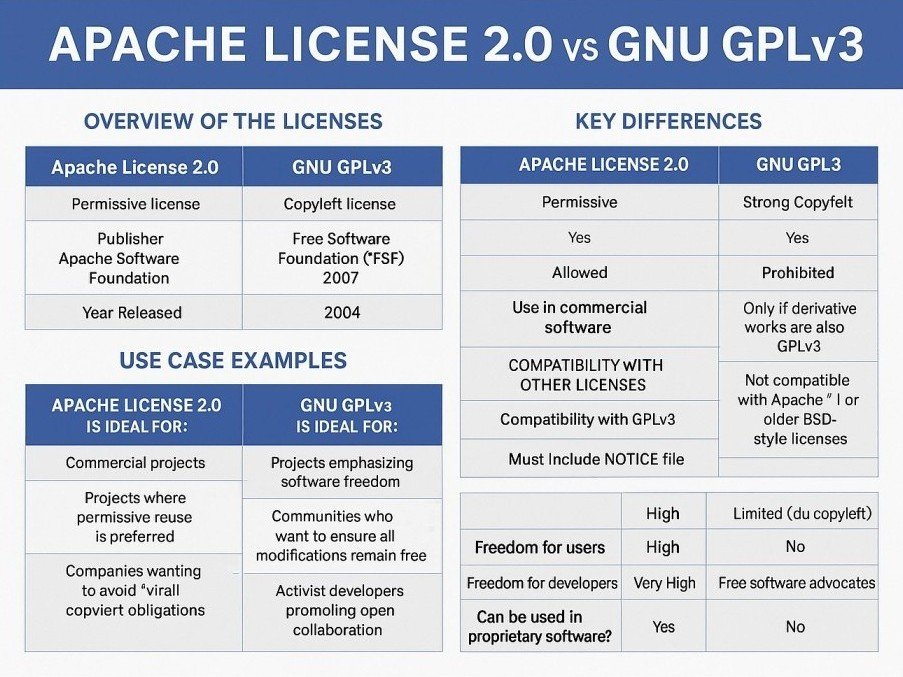
Overview of the Licenses
✅ Apache License 2.0
Published by: Apache Software Foundation
Year Released: 2004
Type: Permissive license
Allows: Free use, modification, and distribution with minimal requirements.
✅ GNU GPLv3
Published by: Free Software Foundation (FSF)
Year Released: 2007
Type: Copyleft license
Requires: Derivative works to also be licensed under GPLv3 (strong copyleft).
Key Differences Between Apache 2.0 and GPLv3
| Feature | Apache License 2.0 | GNU GPLv3 |
|---|---|---|
| License Type | Permissive | Strong Copyleft |
| Patent Grant | Yes | Yes |
| Tivoization | Allowed | Prohibited |
| Compatibility with Proprietary Software | Yes | No |
| Use in Commercial Software | Allowed (no need to open-source derivative works) | Only if derivative works are also GPLv3 |
| Compatibility with Other Licenses | Compatible with GPLv3 | Not compatible with Apache 1.1 or older BSD-style licenses |
| Notice Requirements | Must include NOTICE file | Must include source or offer source on request |
| Trademark Use | Not granted | Not granted |
Use Case Examples
Apache License 2.0 is ideal for:
Commercial projects
Projects where permissive reuse is preferred
Companies wanting to avoid “viral” copyleft obligations
GNU GPLv3 is ideal for:
Projects emphasizing software freedom
Communities who want to ensure all modifications remain free
Activist developers promoting open collaboration
Compatibility
One major advantage of Apache 2.0 is that it’s compatible with GPLv3. You can include Apache 2.0-licensed code in a GPLv3 project, but not the other way around.
However, you cannot mix GPLv3 code into a proprietary or closed-source project — this makes it more restrictive.
Patent Protection
Both licenses include explicit patent grants:
Apache 2.0 clearly states that contributors give users the right to any patents required to use the software.
GPLv3 also includes a patent clause, but enforces stronger protections against patent-related misuse.
Tivoization
GPLv3 prohibits Tivoization, a practice where hardware prevents users from running modified versions of software. Apache 2.0 does not restrict this, giving developers more hardware flexibility.
Summary Table
| Criteria | Apache License 2.0 | GNU GPLv3 |
|---|---|---|
| Freedom for users | High | High |
| Freedom for developers | Very High | Limited (due to copyleft) |
| Ideal for | Companies, startups | Free software advocates |
| Can be used in proprietary software? | Yes | No |
| Must share changes? | No | Yes |
Final Thoughts
Choosing between Apache License 2.0 and GPLv3 depends on your project’s goals:
Want maximum flexibility and easier adoption (even by commercial vendors)? → Go with Apache 2.0.
Want to protect user freedom and ensure all modified versions remain open-source? → Choose GPLv3.
Both licenses are powerful tools that shape the open-source ecosystem. Understanding their differences helps ensure your code aligns with your values and long-term project vision.